
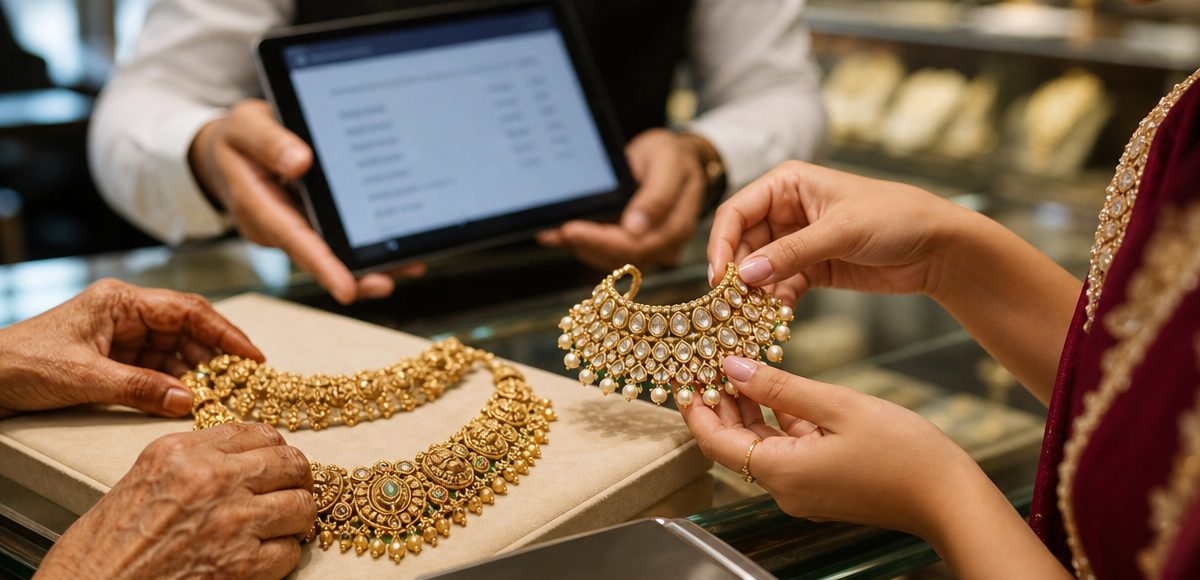
For a long time an Indian wedding necklace was valued by the scale: more grams, more pride. The Economic Times Prime reported on 16 November 2026 that younger buyers are changing the order. They still have a budget, and gold is still the centre of the wedding, but inside that budget they are choosing polki, uncut stones and diamonds, contemporary settings, and a clearer price. The World Gold Council’s Q3 consumer work points the same way. Weddings were 25% of respondents’ expected next jewellery purchase, up from 22%, and festivals rose from 16% to 21%. Investment-led jewellery buying fell from 19% to 15%. People are buying for the occasion, and they are choosier about what the occasion looks like.
A lighter set is a different invoice
A heavy 22K haar is mostly metal. A polki or diamond necklace of the same rupee cost is metal plus stones plus a much higher making charge. If you only remember the total, you will not know how much fine gold you own after the wedding. Ask the bill to split gold weight and rate, stone weight and rate, and making. Then run the gold line on its own. Retailers told the Council that festive buyers did come back as prices eased from mid-October, and that the average weight of each purchase stayed lower. Lightweight designs and exchange offers were what got people to the counter.
₹8 lakh, two weddings
Use 22K at ₹12,055 per gram, in line with the 18 November 2026 IBJA open, and a budget of ₹8,00,000 after GST for a moment so the comparison stays on metal and labour. You can put GST back on at the end at 3%.
- Plain 22K set, making at 8%: gold value is about ₹7,40,700, which is roughly 61 grams. Almost the whole budget is metal you can resell near the 22K buy rate.
- Design-led 22K necklace, 28 grams, making at ₹3,500 per gram: gold value ₹3,37,540, making ₹98,000. That is about ₹4.36 lakh before stones. The other ₹3.6 lakh of an ₹8 lakh budget is diamonds or polki, which do not track the IBJA rate.
- Same design in 18K at ₹9,863 per gram: 28 grams of gold is ₹2,76,164. You save about ₹61,000 of metal and you own less fine gold (21 grams versus 25.7 grams in the 22K version).
None of these is the wrong wedding. They are different assets. The plain set is a gold holding you can wear. The studded set is a gold holding plus a luxury purchase. Families who expect the necklace to fund a later exchange should know the second bill will exchange only the gold line, at the buy rate, not at ₹8 lakh. Put the gold weight and the 22K or 18K rate into the gold karat calculator, add the making charge the studio quoted, and keep the stone estimate beside it rather than inside the gold value.
Exchange still funds a lot of wedding buying
The Council said old-gold exchange remained 40–60% of sales at many retailers through the festive season. A wedding set is often a mother’s haar, a cash top-up, and a new design. Credit the old piece at its buy rate and purity, then let the new design’s making and stones explain the cash you still need. If the new piece is lighter, you may be trading grams for labour. That can be what the couple wants. It should be visible on the estimate.
A wedding budget that buys polki is not the same stack of 22K grams as a plain set at the same price. Split the bill, then calculate the gold.
— Gold Karat Calculator
Summary
Younger buyers in the 2026 wedding season are choosing design, polki and diamonds inside a fixed budget, and weddings are a quarter of expected next purchases. On a plain 22K set, most of ₹8 lakh is grams. On a studded set, a large share is stones and making. Run the gold line in the gold karat calculator so the metal you keep is a number, not a guess.